

Does Conscious Content Creation Exist?
On marketing, social media, and selling.
Last week, I spent nearly all of my time on marketing – I set up an Instagram account, a Pinterest account, a Goodreads, and of course, I re-started this newsletter. I spent so much time on content, that I barely did any mending. Now, I know that the initial setup is a time-consuming task, and content creation or posting will (hopefully) take less time going forward, but the time it takes to simply get a product out there is truly exorbitant. And after that, constant content is required to feed the beast; to ensure more views, more follows, more likes, and, most importantly, more conversions to sales.
I’ve never been one for selling. There is so much pressure, both when working for oneself and especially when working for someone else, to say whatever you need to say in order to “make the sale.” I wrote about it back in 2023, fresh off a vendor call that went horribly awry. The excerpt below is exactly how I felt, and still feel, about the pervasive nature of selling, and the dishonesty a potential sale can bring out in people, including myself.
A quick “quote about sales'' Google search returns a series of Arial Narrow motivational quips on top of backgrounds of oceans, mountain ranges, and rainforest treetop views. These quotes all say the same thing: work hard, make money, trick people, make more money. It’s exhausting to sell, but that’s part of the game. Those at the top of the ladder tell us that to sell, one needs to harden not just their heart but also their ears and their gut, and to do so for the sake of the sale is noble. They tell us that the sellers who can stand it for years on end are worthier humans than those who can’t. One day you wake up and realize you’ve forgotten how to make anything except money. Even now, in my (maybe temporary) state of enlightenment, I’m thinking of how I can design this piece to appeal to the maximum number of readers. I’m thinking of how I can be just irreverent enough to be popular, to get this published, to make more money.
The sales story has convinced us that if we make more sales, we get more money, and if we get more money, we get more happiness. So we “hustle” and we “grind” and we get yelled at by clients and by customers, all in the pursuit of success because we think it will afford us power and happiness and the Key to the Universe if only we had just a little bit more. It’s like hunting for a fix but you’re delivering the high to someone making 5x your salary, and they always look down and say not enough. It’s the ultimate deal of the American Dream: it’s never enough to work hard, or lead, or optimize, or save. You have to drive revenue. Is it inevitable to become a cog like this? Every pause I take gives me a moment of clarity, bringing me closer to a truth I don’t want to believe - that no matter who I am or what I do, I need to keep selling.
I’ve worked for big fashion brands, small luxury labels, and tech startups, and rarely have I found leaders who insist upon transparency. I’m lucky enough to work with a few founders today who I respect and admire for their openness and honesty in the way they conduct business. It’s always the way I imagined running The Ribbit Factory, and it’s part of the reason I think social media can be an asset to a business like this one; to increase visibility, build community, and receive honest feedback from customers. On the flip side, social media (Instagram, TikTok, even Substack, to a degree) is a place that pushes consumption on users from the moment they open up the app. Fast, flashy videos featuring influencers showing off their latest haul are rewarded by the algorithm, and thoughtful dialogue is replaced by character count limitation. We can see a correlation between the rise of Instagram and Tiktok and the increase in fast fashion consumption over the past decade. The chart below shows the convergence of a decrease in clothing utilization (ie; how many times we wear an item before it is discarded – which has decreased by 35% since 2000) and an increase in clothing purchases. The average consumer purchases 53+ items of apparel every year….and discards 65% of their purchases after just one year. (BBC).
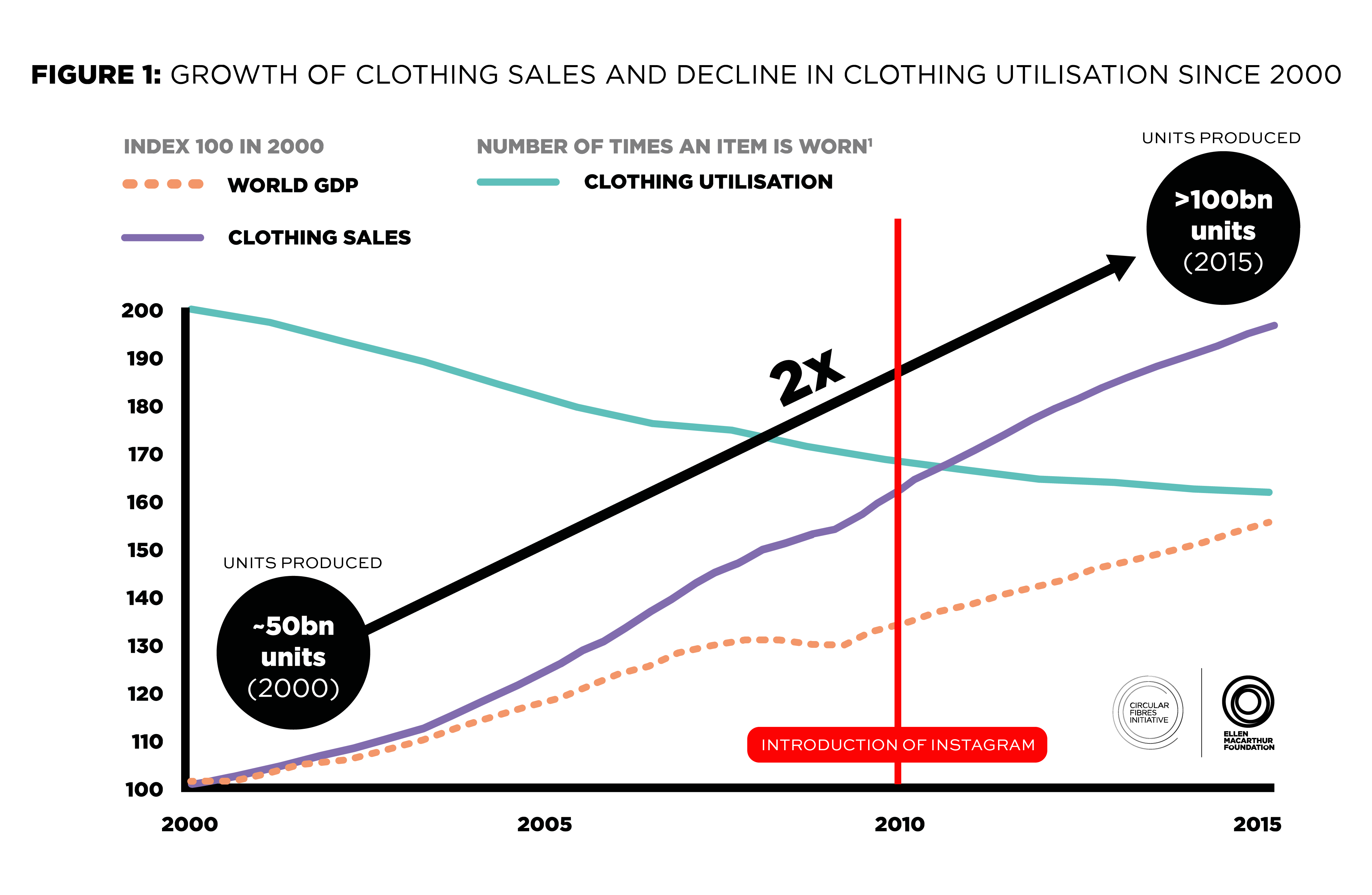
This is troubling for many reasons. Since the year 2000, the average American consumer has decreased their spending on apparel, yet we are purchasing a higher volume of clothing. As a whole, we purchase over 4x the amount of clothing compared to 2000 (Fashion United), yet our average monetary expenditure has actually slightly decreased in that same amount of time (Statista). The advent of offshoring production has given rise to fast fashion and ultra-fast fashion retailers like Zara, H&M, Amazon, Shein, and Temu (among MANY others), who produce so quickly and cheaply that the result is a collective disregard for the value of clothing. When we don’t see the huge amounts of infrastructure and labor required to manufacture a product, corporations can create a narrative that fits their prerogative. And their prerogative is to sell more, faster. Which means dropping prices, eroding quality and creating products that fall apart after 7 wears. (The Economic Times).They push the narrative that products are disposable, and then make them disposable. It keeps profits high and consumers dissatisfied so they feel the constant urge to buy more.
Psychological obsolescence and quality degradation happens across all levels of the industry. In our book club pick, Sundressed, author Lucianne Tonti recounts her experience of working for luxury brand Burberry, adding context to the global industry’s race to the bottom;
“In the last decade the luxury goods industry has been totally transformed by realizing huge growth, aided significantly by expansion into Asia…This reflects the sheer volume of products sold, most of which has come to be mass-produced in much the same way as fast fashion – a side effect of which is over-production.”
“This gets to the heart of one of fashion’s biggest issues, and an issue with manufacturing more broadly. The more units produced in a single production run, the cheaper the price per unit…The result is a system that incentivizes brands to order more so they can sell each garment at a better margin and is exacerbated by capitalism, which has incentivized companies to relentlessly pursue growth for decades.”
Tonti goes on to explain how increasing production and the rapid fire output of new styles, micro-trends, and social media marketing have cheapened the value of clothing; “The temporal nature of each trend and their perpetually moving goalposts instilled the idea that newness is integral to fashion, creating a consumer mindset that could only be satisfied by the gratification of another purchase.”
Building any business requires some level of marketing to increase brand awareness. The fact of the matter is, the most effective place to do that today is on social media. For me, there is a lot of tension around building a circular program meant to decrease consumption and increase apparel longevity while marketing on a platform that profits from speed and disposability. I’m hoping that tension is where honesty and transparency can live. I don’t think I can avoid some level of “sales-iness” when planning marketing for The Ribbit Factory, but I do know that I can now trust what I’m selling. Part of the reason I’m so focused on using Substack is because I think it’s the best way to build open and honest communication between the business and our community. The Ribbit Factory isn’t just a mending service, it’s a new approach to fashion that values garment work, considers the planet, and includes the customer.

With that, drop a comment below to let me know what you think. Have you found yourself buying more after joining social media? What are some of the fun and valuable things that social media has allowed you to find, that you might not have otherwise? Of course, after all of this, I have to say: follow us on Instagram ;), send your friends this Substack, and check out our newly launched website.
As always, thanks for being here.

 | A guest post by
|
Thank you for talking about this. Marketing is both unfortunately questionable and necessary these days to sell most anything. Cutting through the clutter of noise for an audience is even more difficult. And even when thinking through *what* content to create can be time consuming, and after a while feel like you are creating heavily involved "digital toilet paper."
I've been in marketing for a long time and have been giving a lot of thought lately to ideas that are entertaining to your audience first, and easy to produce so you aren't spending lots of time on "content creation."
Not sure if you are aware of or seen this artist @sophieteaart on all handles. But I love the concept of how she goes about both building her audience, selling her art while keeping her values in mind. Might be a an approach you can put your own twist on.
Anyways. Love the transparency and thoughtfulness you are bringing to the table. Hope life is treating you well!